• How We Do It

    How We Do It

    Lorem ipsum dolor sit amet, consectetur adipiscing elit. Mauris sit amet nisl lectus, id sagittis metus.

  • Easy to Customize

    Easy to Customize

    Nunc sapien risus, molestie sit amet pretium a, rutrum a velit. Duis non mattis velit. In tempus suscipit sem, et consectetur.

  • Clean Design

    Clean Design

    Class aptent taciti sociosqu ad litora torquent per conubia nostra, per inceptos himenaeos. Nam consequat risus et lectus aliquet egestas.

  • Works Everywhere

    Works Everywhere

    Nullam a massa ac arcu accumsan posuere. Donec vel nibh sit amet metus blandit rhoncus et vitae ipsum.

  • Web Development

    Web Development

    Suspendisse eleifend nulla in est euismod scelerisque. Etiam lacinia fermentum nunc id imperdiet.

  • Color Picker

    Color Picker

    Nullam tortor tellus, iaculis eu hendrerit ut, tincidunt et lorem. Etiam eleifend blandit orci.

Showing posts with label Travel. Show all posts

Manali - Popular Honeymoon Destination

0 comments


Manali situated at 6398 ft in the Himalayas is a popular honeymoon destination and Mecca for adventure sports enthusiasts. Indians flock to the town even in winters lured by its snow covered peaks and slopes. Foreigners attracted by adventure sports options flock in large numbers to Manali.
Renowned for its snow-covered mountains, scenic beauty, history and culture, Manali, often referred to as the "Valley of the Gods", is situated in Kullu district of Himachal Pradesh. It is often considered a twin town of Kullu, 40 km away.
Manali rose to prominence as a pit-stop on the flower trail in the sixties and seventies. Hippies flocked in pursuit of their utopian dream and popularised Manali in the west.
Manali rose to prominence with the rise of turmoil in Kashmir. The hill town witnesses a rush of tourists during the peak season in summer and again during Christmas and New Year. Tariffs for rooms can more than triple coinciding with the tourist rush.
Manali is also the main jumping-off point for Ladakh, Spiti and Lahaul. Daily buses ply regularly to Leh, Keylong and Kaza from June to October.
Adventure Sports: In addition to temples, mountain landscapes and culture, Manali is a paradise for lovers of adventure sports. Mountaineering Institute is located three kms from Manali town. The Institute organises basic and advance training courses, in trekking, mountaineering, skiing and water sports.
Angling tours are organised in Tirthan and Sainj rivers. Trout and Mahseer found in the rivers are an angler’s delight. Himachal Pradesh Fisheries Department organises angling tournament in April and in September-October.

Trekking:  April to November is the best season for trekking in Manali. Lamadugh Meadows, Solang Valley, Koshla-Tree line are some of the popular treks. Most of the treks are one day journeys.
Manali has some of the finest stretches of white water. Though dangerous, hi-quality rafts and experienced and trained crew make the sport safe.

Paragliding in Manali is an unforgettable experience. Rohtang Pass, 51 km north and Solang valley, 13 km offer great opportunities for paragliding. Solang Nallah is suitable for short flights while Hallan is suitable for high flying. Operators also offer short tandem rides for novices.
Rock climbing, rappelling, Skiing, Ice Climbing, Snowboarding, Ski Touring are some of the adventure activities which can be indulged in Manali.

Tips

  • Many tourists are also lured here by the famous Manali charas. Local police keeps a strict vigil which has brought the number of incidents.
  • Old Manali and Vashisht close for winter from October to May.

History

Manali is named after the Hindu lawgiver Manu. Manali exactly means "the abode of Manu". Legend has it that sage Manu stepped off his ark in Manali to recreate human life after a great flood had deluged the world.
Rakshas, the nomadic hunter tribe and shepherds from Kangra Valley are believed to be the earliest inhabitants of Manali. One of the most popular inhabitants of the city was the ‘nar’.  Manali was part of the erstwhile princely state of Mandi which merged with India in 1948.
Lord Raghunathji, a form of Lord Ram, was believed to be the ruler of Manali and the erstwhile princely rulers ruled the kingdom in trust for Raghunathji. How Raghunathji came to be ruler of Manali has an interesting legend associated with it.
Raja Jagat Singh, who ruled the valley in 17th century, contracted leprosy after he was cursed by a peasant. The remorseful king was advised to install an idol of Lord Raghunathji. As advised, the king brought an idol from Ayodhya and was cured of the disease. Jagat Singh installed Raghunathji on his throne and the Lord became the ruler of Manali.
However, modern Manali history began with the advent of the British. The British developed the land as a sanctuary from the oppressive heat of the plains during summer. They planted apple and released trouts in the rivers of Manali.
Manali was part of the princely state of Mandi, which merged with India in 1948.

Culture

Fairs and festivals are a vital part of life in Manali. Dassehra is celebrated in a grand way. Other festivals which are celebrated on a grand scale are Basant Panchami, Hadimba Devi fair and Winter Carnival.
Roerich Art Gallery houses paintings by Russian artist Nicholas Roerich. The gallery has also preserved original creations of the Himalayas done by Roerich.

Shopping

The region is known for its handicrafts and handlooms. Wood has traditionally remained a favorite item for handicrafts. Popular items for shopping in Manali are embroidered woolen shawls, Tibetan handicrafts, antiques, souvenirs and inlaid silver jewelry. The Mall Road is the best place for shopping in Manali. Fruit products, honey and apricot oil produced locally can also be purchased in the valley.

Where to stay

The Mall is lined with hotels and restaurants. Manali offers wide range in accommodation which includes luxury resorts, river-side cottages, deluxe hotels and 3-star budget properties. Manali also offers home stays which are a good option to enjoy nature and culture of the locals.


Read more

A walk through the city of Seven Pagodas

0 comments
Mahabalipuram is believed to have influenced temple architecture in Cambodia and Java too
The little girl runs and crouches behind the big boulder. She catches me smiling at her and puts a finger to her lips. It is a pleasant Saturday afternoon and the soft rays of the sun light up the sandy shores. l follow my gaze and see small hillocks, big boulders, rock cut temples and carved caves set amidst casuarina trees.
The blueness of the sky and the waves stand out against the sandy shores and the stony sculptures. A bunch of children are playing hide and seek. All of a sudden, I feel like a child again. The weight of three decades is removed from my shoulders as I go back to my childhood. We are a bunch of motley kids looking pretty in our uniforms and running and screaming wildly as we find freedom from our classrooms. It is the annual excursion to Mahabalipuram.
Several years later I am in Mahabalipuram again, lost in the sculptures. I am not seeking academic information or a place to picnic. It is an eagerness to explore, a childlike curiosity, a joy in discovering something new that overwhelms me.
The crowds soon gather. There are swarms of touts, tourists, vendors and visitors vying for attention at the historic site. The history of the coast, however, goes back to ancient times when maritime trade flourished here with Rome, China and other South East Asian countries.
Mahabalipuram became a thriving port during the Pallava reign between 6th-10th centuries. Referred to as Kadalmallai or Mammalapuram, after Pallava king Narasimhavarman 1, who was nicknamed Mammala or ‘wrestler’ it finds mention in works of ancient travelers and historians like Periplus, Ptolemy and Hiuen Tsang.


The structures at Mahabalipuram are among the oldest existing examples of Dravidian architecture
Interestingly it is documented in “Carta Cartalana”, a 14thcentury Spanish world map as “Setemelti” referring to “Sette Templi”, the obvious reference to the Seven Shore temples, of which only one remains today.
Standing tall against the ocean, the World heritage site, houses three shrines dedicated to Vishnu and Shiva. A guide tries to lure me by narrating the tale of the “tsunami temple”, referring to some sculptures that were found under water after the tsunami. “Underwater excavations are still happening madam”, he says, adding that the locals believe there could be a city buried underneath the waters. A local gypsy walks with beads and necklaces on her arms, trying to grab my attention.
There are three temples of which two Shiva Temples face east and west respectively built by Narasimha Varman II. The third is the Vishnu Temple built by Narasimha Varman I. Carvings of various Hindu Gods and Goddesses, such as Brahma, Vishnu, Shiva, Lakshmi, Parvati, Ganesha, Skanda , Narasimha and Durga, are depicted here.
The central shrine is in the form of a rectangle. Here the sculpure of Vishnu is found reclining; hence, the deity is known as Sthala Shayana Perumal or Ananthasayana. It is said that Vishnu reclines on the floor listening silently to the sounds of names. It is pretty dark in there and one has to strain to catch the glimpse of the reclining God. The grand temple is surrounded by mandapas and compound walls.


Hundreds of highly skilled sculptors toiled to create the wonders at Mahabalipuram
Legend has it that a great flood consumed a city of the east coast of India, more than 1500 years ago when the Gods grew jealous of its beauty. The sea has its secrets and some were uncovered post the tsunami, when recent underwater excavations have shown some structures hidden under the waters.
Excavations on the shore revealed the remains of an ancient temple dedicated to Shiva located to the south of the shore temple. A beautiful ring-well made of terracotta, a shikara stone are among the others which were found within the temple complex. According to the local traditions these structures are the remains of one of the six temples believed to have submerged. More temples were unearthed and we went in search of them.
We walk over to the monolithic rathas which are carved out of a single boulder. A tribute to the Pandavas of the Mahabharath, the Pallavas have built five Rathas or chariots called Dharmaraja  (Yudhishthir), Bheem, Arjuna, Sahadev-Nakul and Draupadi. The monolithic temples are called locally as Rathas as they resemble the processional chariots of a temple. They were carved during the reign of King Mahendravarman I and his son Narasimhavarman I. Gods, kings, mortals and animals are sculpted on these temples as some of them are three storied like the Dharamaraja ratha and single storied like Draupadi ratha.


Erosion has taken a toll on several monuments but what remains, still speaks eloquently of the brilliance of Pallava architecture
I then see a beautiful bas relief which is sheer poetry on a single rock. I am looking at Arjuna’s  Penance which narrates the story of Arjuna as Kiratarjuniya obtaining the weapon Pasupatha from Shiva after a severe penance. Set on the banks of the river which depicts life running its own course through images of nature, wildlife, man, it is also interpreted as the story of the descent of the River Ganges.
We walk past more rathas, cave temples and mandapams and watch as more stories come alive. The Varaha Cave, the Mahishamardini Mandapam, the Trimurthi cave, Ganesh Ratha, Govardhanagiri Panel, Konheri Cave, the Pindari Rath, the Krishna Mandapa – one is lost in the world of sea, sand and sculptures. I head to Krishna’s Butter Ball near Ganesh Ratha. It stands out there as everyone loses their balance while attempting to pose against the rock, even as it balances precariously on its own. A bunch of children were playing hide and seek. All of a sudden, I felt like a child again lost in the past.


Read more

In defence of train journeys

0 comments

Nothing compares with the romance and thrill of a train journey
Whenever I tell friends or colleagues that I’m taking the train instead of flying within the country, they look at me as if I am insane. Why would anyone choose Indian Railways with its decrepit trains and smelly stations over newly-renovated airports and somewhat affordable low-cost airlines?
I have a simple answer: I love travelling by train; it makes me happy. Thanks to my adventures as a child while criss-crossing the country on the Indian Railways network along with my siblings and dog, I’ve always associated trains with leisure, with family, with adventure and with the journey being more important than the destination.

My earliest train memory is etched in my mind. It’s an image of my sisters and me screaming blue murder because a man who had turned up his eyelids to make it look like he was blind, barged into our coupe when my Armyman dad was away and tried to make off with a large basket containing our food supplies. Given that the family then comprised three hungry girls under 10, a bawling baby, an alarmed mother and a half-Bhutanese terrier, it’s not surprising that the potential thief dropped the basket and exited hastily after being hit with our reaction.
Train journeys have come to be associated with leisure and old world charm
What is it about train travel that makes it so special? A close friend articulated it well recently. She looks at train travel as time she gets exclusively for herself. It’s ‘me’ time. She’s right. Train travel is like meditation. I can spend hours daydreaming during my journey; I read, stare out of the windows or into nothingness and finally fall asleep to the somewhat reassuring clacking of the wheels.
Being on a train alone is almost like being in a cocoon. I feel insulated from the demands of family and friends; from worries of the workplace; from the entrapments of the digital age and from the urban cacophony that is a vital, but unwanted, part of my daily life. I will, however, admit that you need a high level of tolerance for the deteriorating level of hygiene in trains and stations to be able to
enjoy a train journey.

In contrast, air travel is more about the destination. It holds no charm for me. It’s impersonal and clinical. It’s literally and figuratively cold. It generates no warm, fuzzy feeling within me. Airports have no character; they are clones, giant pods of humanity in a rush to get to their destinations.
Rail journey is an expedition through cultures and across lands
At the end of a holiday, I’d rather take a train back to work than fly because a train journey eases me into reality gently. It gives me a buffer of a few hours of peace between hectic holidays and hectic work. It allows me to come to terms with the fact that my break is over. Importantly, it allows me to stretch my legs. Air travel does no such thing. Given that many of us fly to save time in order to join work upon landing, air travel brings me back to reality cruelly and suddenly. There’s no waiting time, no easing in, no time to readjust before the fun ends and work begins.

The article was first published in the English daily DNA.


Read more

Shubho Durga Puja: Eat, pray and live

0 comments

The dark grey monsoon clouds disappear to give way to clear blue skies and golden sunshine. The season of Sharad, as the special season preceding autumn is called, is fondly awaited in West Bengal for its pleasant weather and brightness after the dull and dreary monsoon.

It seems that nature too decks up for the biggest festival of Eastern India – Durga Puja. During the Puja, Goddess Durga is worshipped along with Lords Ganesh and Karthik and goddesses Lakshmi and Saraswati.
Navratri is celebrated all over India at this time of the year and Durga Puja coincides with the last five days of the Navratri. Year-long
preparations go into making the festival grand in every aspect and people forget all their worries and pain to celebrate the five days and welcome the Mother Goddess.
Mythology has it that Lord Ram worshipped Goddess Durga to seek her blessings before conquering Lanka. Since, then Durga Puja has come to symbolize the triumph of good over evil. According to mythological tales, the goddess was born to rid the gods of the tyranny of Mahishasur.
Mahishasur had a boon that no man could kill him and hence, a woman had to don the mantle of a warrior to destroy the evil. In modern ages, Goddess Durga has also been symbolical of woman power and the commemoration of the Divine Mother.
Local folklore in Bengal also propounds the idea that the Puja is a celebration of the Goddess’s homecoming to her parental abode, along with her offsprings: Ganesh, Karthik, goddesses Lakshmi and Saraswati, after vanquishing Mahishasur.

The worship of Goddess Durga and the festivities started generations back during the zamindari system in Bengal. As the zamindar
families prospered, the festivities and the grandeur also grew in scale. Soon it became a matter of honour and the zamindar families competed with each other to organize the biggest and the best Durga Puja.
The age-old Pujas still take place in some of the zamindar palaces where the present generations are carrying on the tradition. Other than the traditional Pujas, every area in Bengal has 3-4 committees and clubs who organise their own Pujas. Pandals are erected on roads or community grounds for housing the deity during the festival days.
Residents of the area contribute financially and also volunteer to perform various duties in organizing the Puja. The clubs also compete with each other to win the title of the best pandal or the best idol or the best decorations and so on.

Over time, Goddess Durga has made a long journey from the traditional idols in zamindar houses to theme-based idols at the Pujas today. Today, the Goddess campaigns against global warming, women and children issues, anti-terrorism and various other socio-political causes.
For years, the idols have been crafted by potters in a locality in North Kolkata, known as Kumortuli. A potter’s community, the residents of the locality earn their living by crafting idols of gods and goddesses. Though, most of the idols for Pujas organized in Bengal
are sourced from Kumortuli; in some of the zamindar houses, the craftsmen are invited to stay as house guests and make the idol.
In recent years, idols from Kumortuli have also been exported to various countries like US, UK, Bangladesh and UAE. It takes almost six months to craft the idols for the Durga Pujas. Today expert artists also try their hands at giving the goddess a more contemporary and designer look.
During Durga Puja, the city of Kolkata enjoys its days of glory. All everyday activities come to a standstill as the people are involved in the festivities and merry-making. Work is forgotten as Calcuttans dedicate these five days to doing what they love best: eating, endless addas (chat sessions), family gatherings and ofcourse, pandal hopping to visit the Goddess in her many avatars.

It’s almost as if the city never sleeps during these days of the festival. The entire city is decked up with lights. The preparations like building the pandals, setting up the lights and decorations, start months before.
A unique aspect of the Durga Puja is the shopping for new things that start some months before. It is at this time of the year that you will
get the best discounts and bargains in Kolkata. Bengalis reserve these months for splurging on new clothes, decorating their homes and also buying household appliances and gadgets.
The five days of the festival is more like a fashion show en masse. One gets to see the latest in fashion, brands, designs and accessories
all over the city. The biggest Bollywood trends become the mantra for Durga Puja costumes.

The five-days of fun and exuberance come to an end with the immersion of the Goddess in the Holy Ganges on Dashami or Dussehra. Married women bid farewell to the Goddess by smearing the idol and each other with vermillion and gifts of sweets, with entreaties to come back soon.
After waiting an entire year and celebrating the festival for five days, it’s extremely difficult to see off the Goddess and many tear stained eyes are found wishing the Goddess stays forever. Much beyond the worship of the goddess, the five days of the Durga Puja in Kolkata is a utopia for many, when life is all about happiness and all bitterness are buried.
With the immersion of the Goddess, it’s a return to the real world and mundane activities. Calcuttans start counting days for the festivities next year, when the goddess will return to wipe away all dullness and gloom. As the Goddess travels back to her abode in Mount Kailash through the Ganga, the despair among her followers is shredded with hope and cries of “Ashche Bochhor Abar Hobe!”


Read more

Phansad Wildlife Sanctuary

0 comments

A splendid place for nature lovers, Phansad Wildlife Sanctuary has one of the densest populations of wildlife around Mumbai. Though the sanctuary boasts of several species of fauna including leopards, it is more known for its birds, both resident and migratory
Popular for its feathered residents, the sanctuary houses over 720 species of flora and 279 species of fauna that include mammals, birds, snakes, butterflies, etc. Situated in the state of Maharashtra near the Konkan coast, Phansad is 140 km from Mumbai.
Spread over just 52 sq km, the sanctuary is one of the lesser visited sanctuaries in the country. Nonetheless it offers a lot in terms of biodiversity for nature lovers and photographers.
The coastal woodland ecosystem of the Western Ghats can be found in the sanctuary. The sanctuary is popular destination for trekking and birding. Four major trails run through the sanctuary.
A trek through the sanctuary provides the chance to spot sambars, barking deer, panther, wild boar and hyenas. Giant Indian squirrel is a major attraction of the sanctuary. Leopards can also be spotted in the sanctuary.
The sanctuary is home to over 150 species of birds that include Malabar piped hornbill, Asian paradise flycatcher, yellow footed green pigeon, plum-headed parakeet, green billed malkoha, etc. Migratory birds visit the sanctuary during November-January. Phansad is also home to over 31 species of snakes that includes russell’s viper, Indian rat snake, Indian rock python, etc.
The sanctuary once served as the hunting ground for Siddi Nawabs Murud-Janjira. The Nawab constructed roads and water bodies within the forest.
In order to preserve the rich biodiversity of the region, the forests were declared as wildlife sanctuary in 1986.

Where to stay

There are limited accommodation options in the wildlife sanctuary. Budget accommodation in tents, PWD rest houses and s inspection huts are available in the park. Since Phansad is a one-day destination, many tourists prefer staying at Kashid (10 km) where there are more accommodation budget and mid-range options available. Alibag also has more options to stay.

Where to eat

There are no places to eat in Phansad Wildlife Sanctuary. Small eateries can be found outside the sanctuary gates. Kashid, 10 km from the sanctuary, has several shacks which offer scrumptious seafood. Kashid has several resorts which have restaurants that serve Indian, Chinese, Continental and Italian delicacies.

Best time to visit

Phansad Wildlife Sanctuary is an all weather destination. However, summers could get a little difficult because of the heat and humidity. Migratory birds visit the sanctuary between November and January. November to March is the best time to visit the sanctuary.


Read more

Palolem - Travel Destination

0 comments

A popular tourist attraction in South Goa, the beach is spread amidst a beautiful coast surrounded by hillocks and palm and coconut trees. The beach is an ideal place for different types of water sports. Home to one of the most beautiful beaches in Goa, Palolem is a natural bay surrounded by lofty headlands on either side.

Tips

  • Beware of stray dogs.
  • There are no ATM's near the beach. Ensure you carry enough money with you.
  • Local buses in Goa are not air-conditioned and at times quite dusty.
  • Bus station to Palolem is walkable but might not be the ideal option on a hot sunny day.

Culture 

Unfortunately Palolem has been saturated by travellers, hawkers and over priced sellers: it is sometimes difficult to walk up the beach at high tide due to the restaurants jutting into the cresting waves and you will certainly be asked about your plans for dinner a few times.

Shopping

Palolem is not a great place to shop but there are great crafts people on the beaches. There are some mini bazaars on the beach front. Some of the stores are now owned by westerners offering western labels at cheap but fixed prices.

Where to stay

Basic accommodation in non-peak tourist season should cost Rs 200-500. Nice rooms with TV, etc. easily can go for around Rs 1,000 or even more. If you're looking for the better value, try next beaches to the south. Though there are plenty of beach shacks along the Beach advance booking is hard as the owners do not take booking on phones. Most of the average cost shacks would cost about Rs 500 -700 and are very basic. Do check before you pay. The beach huts are temporary and thus are cheap so don’t forget to bargain.

Where to eat

Most places in Palolem serve both international and Indian food.

Best time to visit

The best, and most popular, time to visit Goa is during the cooler months of November to March, when the weather is wonderful. Arriving in October, at the very start of the tourist season, you’ll find beaches luxuriously empty, but many facilities, such as shops, restaurants, beach shacks and beach-hut operations, aren’t yet up and running. Many Goans, however, feel that the monsoon, which douses Goa between June and the end of September, is when the state is at its very best.

Read Full Article


Read more

From Chennai To Munnar

0 comments
They say “Journey is more important than the destination”
… This is not about any particular city or any specific destination. This is about one such trip where the journey was more vital than the beautiful destination ‘
Munnar’. Here it goes like this…

It was October of 2006. And I was left alone in
Chennai… with most of my friends leaving the town for some better opportunities elsewhere. I was also bound to leave for Mumbai in December. I had a trip to Kerala in my mind for a long time, but somehow it was getting delayed every time and I wanted to do it before leaving Chennai. This was on 24th Oct ‘06 when I was sitting in my office and it was a holiday on 25th Oct, Wednesday. It was this time when I decided instantly of doing my so long awaited Kerala trip. I thought of taking leave of two days i.e. 26th, Thursday and 27th, Friday and clubbing it with weekend. So, I was effectively having 5 days to explore Kerala. And there I was, all set for solo ride to Kerala. After all, all you need to have is a good camera, willpower and your Beast (ThunderBird 2005 model). And with all the trust in my Beast I started next day.

Day 1 – 25th Oct ’06, Wednesday – I started around 5AM from
Chennai to reach Trichy by 10 AM. (320 kms). There I met a fellow member of my motorcycling club ‘Madras Bulls Motorcycling Club’ - Simmrit and had a great lunch at his place. Thanks mate! Started again around 2PM and after a long ride of more than 5 hours, I finally reached Munnar by 7.30 PM. I found a decent guest house and retired for the day. It was a long and tiring day as I covered 620 kms that day, but still it was the simplest day of my four day trip. More was yet to come!!!

By Road: 135 kms from
Kochi; 300 kms from Thiruvananthapuram; 150 kms from Coimbatore; 600 kms from Chennai
Nearest Airport: Cochin

Places to See: Top Station (35 kms), Mattupetty Dam (14 kms), Tea Museum, Devikulam (7 kms), Chinnar Wild life Sactuary (60 kms)

Nearby places:
Ernakulam (135 kms), Periyar Wild life Sanctuary,
Thekkady (110 kms), Komarokam Backwaters (170 kms)

Day 2 – 26th Oct ’06, Thursday – I decided to look around some places near
Munnar, and so after having a light idli-wada breakfast started for a tourist spot known as Top Station. This is a mountain top and is 35kms from Munnar. This mountain lies on the border of Tamil Nadu and Kerala, with one side falling in Tamil Nadu and other in Kerala. As I left Munnar I was mesmerized by the green-all-green tea gardens. The fresh tea gardens and their magical aroma bounds you and you can’t help but to stop there for a while and appreciate nature. As I moved a few kms ahead I spotted a dam and saw a diversion towards the same. I took the diversion and there I was on Mattupetty Dam. I spent some time there and moved ahead towards Top Station. There is said to be a ‘echo point’ on the way to Top Station but I missed that somehow. I must admit that I was in a hurry to reach Top Station. It was because my SIM was not working in Munnar though I had activated the roaming service and I had to make an urgent call. At that time, a weird thought came to my mind out of no where. I thought of reaching the mountain top and walk in a few meters towards Tamil Nadu side and try my Chennai’s connection. Having no other choice I thought of giving it a try atleast. So, I started rushing towards Top Station. As I was about to reach top station, it started raining. In some time I reached the Top station to find it a bit foggy. I parked my bike and moved in to Tamil Nadu side of the hill. Just few meters and ‘beep-beep’ – few messages were delivered to me in no time. Yeah! there was some signal. I made the urgent call after which I felt relieved and was ready to enjoy the trip! I walked back to Kerala :) and had a cup of hot tea at one of the few stalls up there. After spending some time there I started back in pretty relaxed mood. Luckily, it also stopped raining. Now, I was actually enjoying the ride, the curves and the mountains. It was then, when the inevitable happened. On one of the curves I had a fall, I think it was mainly because of the overconfidence that might have crept in after doing around 100kms of ghats. I was doing 60-70 on curves when this happened and I swear, after that my speed reduced to max of 40 throughout on hills. I was not wearing gloves at that time so left palm got badly brushed and bruised. Somehow, I reached back Munnar around 4PM and moved directly to the dispensary. After some dressing & bandage I thought of taking rest. So, I relaxed in my room and planned the next day’s route. For next day, I finalized: Munnar –170kms - Komarokam – 120 kms - Thekkady. Just 290 kms of ride in one day! A cake walk!! * Worst assumption and mistake of my entire trip *

Day 3 – 27th Oct ’06, Friday – I started around 9AM towards Komarokam (170 kms). I underestimated Kerala’s uncertain weather (rather certain rains) and did not provide cushion for Kerala kind of roads (all curves). Well, driving there was all together a different kind of experience but at the same time I was not able to stick to my naïve schedule. I was unable to come out of last day’s trauma and was not able to do 70-80 speed on curves. I took a break for lunch some 70 kms before Komarokam in Kothamangalam around 2.00 PM and it started raining heavily. I was trapped there helpless.. waiting for rain to stop but all in vain. At this time a strange feeling started creeping in. I started feeling lonely and I could feel that emptiness. I started feeling like I have come too far away from home and lost somewhere in some unknown land. With such feeling inside and looking at the heavy rain I decided to skip Komarokam and move on directly to
Thekkady. I enquired about the way and distance and understood that Thekkady is around 80 kms from there via Pala. I waited some time for rains to stop, but it did not. So, I thought of continue riding sharing same trust with my Beast which I always had. I finally started from Kothamangalam around 3.30 PM. I kept driving in the suggested direction, crossed Pala and around 5.30 PM I stopped by a road side bakery as it started raining heavily. Here again I enquired the distance to Thekkady and they told me 82 more kms. Damn! I had been driving for last 1.30 hrs and still 82 kms.

I started immediately without wasting time any further and then the tough time began. It was raining heavily and I was able to match 30-40.. By 6 PM it was complete dark and I was drenched to the soul. Shivering in cold but still driving. Previous day’s wound completely wet and paining, but still driving. Some time later I entered into the ‘zero-visibility zone’. Thick fog, drizzling, complete dark, freezing cold, shivering and speedometer showing 15kph. I was not moving.. I was indeed crawling. But, I decided not to stop and I kept moving.. I was on bike and drove non stop for more than 2 hours with all the perseverance to reach
Thekkady the same day. I checked the time and it was around 8 PM and I was still driving. I looked around. It was complete dark, constantly raining, no vehicles, no sign of life on road and among all that one drenched soul. That was it! Somewhere around 15kms before Thekkady I gave up. Even my bones were freezed at that time and as soon as I saw ‘Hotel, Restaurant & Bar’ neon signboard I moved in. First question – Is there any room available?.. Second – Do rooms have geyser/hot water?.. All affirmative and I checked in. I don’t even know name of the place.

Guest house/ Hotel Accommodation available in all ranges from economical to star stays.

For good south Indian food one can try out Hotel Sarvana Bhavan
Try authentic south Indian snacks (on banana leaves) at any local roadside snacks shop.

Day 4 – 28th Oct ’06, Saturday – I started from whatever that place was to
Thekkady around 8AM. Thought of covering Periyar and touching plains before 2PM as somebody told me that every day it rains heavily after noon and riding in rain was last thing that I could have considered after having enough of it the last day. I reached Thekkady/Periyar around 8.30 AM. Next boat ride on Periyar lake was scheduled at 9.30 AM and after that 11.30. I checked and came to know that 9.30 boat was full. Frustration that started to build up last day, now was becoming dominant and prominent. I sat there on a rock for few minutes, with my head down and trying to compose myself. Then I gave it some serious thinking. 11.30 boat ride will get over by 1.30 PM, implying no way of touching home the same day, that in turn leads to one extra day of frustration. Damn it! Then I remember seeing a milestone reading out loud ‘Theni – 70 kms’. So, may be there is a way to touch Theni in time without facing Kerala rains, and once I reach Theni I was sure that I could reach Chennai the same day. I took just two snaps of Periyar lake and decided to explore it some other time. Anyway, even if I would have stayed I would not have enjoyed it much with that feeling of frustration and emptiness which by that time crept deep inside me. So, I decided to move on with only one target in mind – to reach home ASAP. I started from Periyar around 9.30 AM and was in Theni around 11 AM. Had my brunch there and again started at 11.30AM. Now the road looked familiar and I ripped. I touched Trichy around 2.30 when I saw clouds building up. So, decided not to stopover at Trichy and so I kept moving. And 50 kms after Trichy IT started again - Rain (no! not again). I did not stop, thinking that atleast after 10-20 kms it will not be raining. It was 3.15 PM at that time. I kept moving and moving and moving trying to cover as much as possible during day time itself. I did not stop anywhere for lunch. I was not able to catch speed, but I kept moving. Two and a half hours of continuous driving, again in non stop Rain, and 5.45 PM, it was dark when I reached Villipuram. I stopped there to treat my rain soaked and empty stomach. Some breather to stomach, but, no respite from Rain! I waited for some time and finally gave up. To hell with Rain! And I was on the road again. Now it was even more difficult. It was raining heavily, with no street lights, road with unexpected potholes and above all I was unable to use visor of my helmet. It was a real tough ride throughout but atleast after Tindivanam four lane toll road till Chennai helped a bit and on this road I was able to maintain speed of 60 kph. Stopped only once for tea and was at home around 10 PM.

Overall it was a tough and hence a GREAT ride! I was not able to take many photographs due to rains, as I had to double pack my camera.


Looking back I think the best part of this ride was the trust that I shared with my Beast and it surely lived upto that. It gave me confidence to move on and on… 4 days of rough terrain and bad climatic conditions & 1545 kms without any break down or hold up. Hats off!! Even after the fall, when I got bruised the person who helped me with first aid (a gentleman cab driver) asked me whether I will be able to ride? I said yes, then he asked is your bike okay? I said ‘it MUST be okay’. He asked me to check it… and single kick… Vrooooom!!! There I was… on the road again…


Overall Trip – 4 days/ 1545 kms.

Experience – Regression testing / Spine chilling
Learnings - Do not be overconfident on your riding. Do not underestimate ghats, hills and curves. Do not make overoptimistic plans. Do not ever underestimate Nature (Rains), pay respect and always provide cushion for it.


Read more

Stunning cascade of Thommankuthu

0 comments
Thommankuthu waterfall near Thodupuzha is an ideal abode for enjoying monsoon delight.Cascading down in seven steps, the beauty of the adjoining Ezhunilakuthu waterfall unfolds gradually with pools formed at each layer.

The abutting cascades at Thommankuthu, Ezhunilakuthu, Koovamalakuthu, Thekkanthonikuthu, Kadachiyaarkuthu and Palungalkuthu are all alluring. However, Thommankuthu is considered the most dangerous one of the group.

Nymphs are believed to have bathed in these natural splendors. Rare medicinal herbs envelop all the seven pools at Ezhunilakuthu and hence the belief that a dip in these pools cures one of any disease.

Thommankuthu is only one kilometer away from Ezhunilakuthu and the thrilling journey through the forest, is sure to be a memorable one. The sight of the seven-layered cascade from the broad rock beneath is stunning.

Adventurous tourists can go for a twelve kilometer km long trek up the Thommankuthu waterfall. However, it is advisable to avoid trekking during monsoon season. Tourist entry pass to the spot is issued only from 10am to 6pm. A plunge into the river that gushes through the smoothed rocks is refreshing.

Interested in visiting a tribal village within the forest? By procuring special permission from the Forest Department and guided by a forest guard you can stride up fourteen kilometers to have a feel of the tribal life.

Thodupuzha is the  nearest town where you can  find decent hotels and lodges apart from guest houses . Tourists can savor the rich taste of the traditional Kerala cuisine at these restaurants.

How to reach Thommankuthu:     

By rail: Ernakulam railway station is about fifty eight kilometers from Thodupuzha, whereas the Kottayam railway station is at a distance of 60 kilometers.

By road : Thommankuthu, which lies in the border of Karimannur, Vannappuram panchayats, is about eighteen kilometers from Thodupuzha. It is easier for those from the Ernakulam side to take the Moovattupuzha-Pothanikkad-Vannappuram route. Thommankkuthu is 35 kilometers away from Muvattupuzha.


Read more

Kochi Backwaters

0 comments
Longing to take a rejuvenating glide into the serenity of village life? Nothing could be better than a boat ride caressed by the soft ripples of Kochi backwaters.  The journey beneath the concrete bridges becomes all the more charming as it is sure not to play havoc with your budget.

You will have to agree with the Spanish traveler who scribed in his memoirs that no journey through India is complete without experiencing the rail journey through Ootty-Coonoor and boat ride through Kochi-Varapuzha water canal.


The mesmerizing journey that starts from High Court junction at Ernakulam provides a beautiful glimpse of the broad backwaters that embraces Kochi. In their journey to Varapuzha, the boats are anchored at more than twenty docks. 

'Lonely Planet', widely acclaimed as the 'Traveler's Bible', contains vivid description of this relatively unexplored waterway. Despite its international recognition, the native folk often remain unaware of the unique experience offered by the journey that links fourteen lush green islands.

The boat-ride provides a kaleidoscopic view of the vibrant cultural life  against a natural backdrop. The solitary boat rider and the fisherman who thuds hard on his boat to attract customers from the distant island towards his catch are but a few isolated images that stay back in mind long after the trip. Barges that contain liquid ammonia gas too sail by.

The meticulous eyes of foreign tourists have not evaded even the native boat travelers. It seems it was while traveling in these boats that they came across the largest number of 'half-clad men' in Kerala. The taste of toddy and the hot tinge of fish curry served at the riverside shops remained fresh in their taste-buds despite reaching the distant Egypt.

No wonder, the ride through the Kochi backwaters itself is the highlight in Fil Franperson's work 'Hidden Kerala', which has been written for KTDC.

The boat passes through Mulavukadu, Korumkotta and Vaduthala to reach Chittur where it stops for a refreshing break.

The island of Moolambilly, seen at the other side, is famous for its earthen pots. So exquisite were those vessels moulded at Moolampilly that during the Indo-Chinese war, it was rumoured that these pots were manufactured in China itself.

The boat resumes its ride through the islands of Pizhala, Kothadu and Chennoor before it reaches Varapuzha. The boat anchors beside the ancient St. Joseph Mount Carmel church. The cultural remnants of  the work of early missionaries attract tourists to Varapuzha. Crematorium of twelve missionaries could also be seen here.

The boat ride from Ernakulam to Varapuzha takes about one and a half hours. If your eyes long to have yet another glance of the picturesque backwaters you can return to Kochi by boat itself. Or else, you can get down at Cheranallor and catch a bus to Kochi. Taxi service is also available.

Accommodation can be arranged at resorts in Korunkodu and Kothadu islands. Home-stay facility is available at Chenoor and Kothadu.

Extracted from ManoramaOnline


Read more

A Must Read for all those taking Flights to Seattle!

0 comments
This metropolitan is the largest city in the northwest Pacific in the state of Washington. This major sea port lies about 114 miles south of Canada. It is also the largest cultural, educational and economic centre of the region. It is the home to about 3.4 million inhabitants. Those taking flights to Seattle will be delighted to know that it is the 15th largest metropolitan area in United States.
It is the birth place to rock music and the home of Software giant Microsoft. It also has a reputation for heavy consumption of coffee. The city has some amazing places to visit. We shall discuss some of them in details.


The Space Needle – built during the 1990’s, the tower is a major landmark and a symbol of the city. It is 605 feet high and weighs 9,550 tons. It is the tallest structure on the Mississippi River. Those taking Seattle flights will be amazed to know that you can reach the top of this tower via elevators and you can reach the top point in less than 45 seconds where you can get some of the amazing views of the town which you must not forget to capture. If you a visiting the city for the first time this place is surely a must visit. 

Washington States Ferries – this is the states largest tourist attraction and is always on the top list for those taking flights to Seattle. It is the largest ferry system in United States and the third largest of the world. It is the best and the most beautiful way to explore the gorgeous waters and mountains. While you are on board you will notice the sparkling water, cityscapes, snow caped mountains and the call of the gulls. It is the best way to explore the city in a luxurious manner with friends and family. So if you are visiting this city don’t forget to book your ferry tickets for a weekend trip. 

Seattle Aquarium – this underwater aquarium attracts a lot of people to the city. It is a huge underwater tunnel which in recent time was opened for public visit. Those who wish to visit this place must book their tickets in advance so as to avail cheap flightsto Seattle. You will surely have an amazing experience as you can get to feel the glowing jellyfish, sea anemone’s soft tentacles and sea otters. It is a great place to discover some fun. There are many cafes and restaurants nearby where you can taste amazing dishes prepared using fresh sea fishes. The nearby gift shops are great places to buy your souvenirs from. 

Pike Public Market – located near the waterfront of the city it is the oldest public market of the town. It is the business place for the small farmers, craftsmen and merchants. The market still remains a tourist attraction. Built on the edge of the steep hill it consists of several lower levels where you can shops of antique dealers, comic book seller and small family owned restaurants where you get to taste some of the famous local dishes. 

In the upper part of the market you will find fishmongers, fresh produce stalls and craft stands. It is a must visit for those takingcheap flights to Seattle. Those taking flights to Seattle must not forget to visit place like the Space Needle, Washington States Ferries, Seattle Underground Aquarium, Pike Public Market and many others.

About Author
Robert Moore is an independent Travel Agent consultant who advises and counsels Cheap Flights to New York, how to book flights,last minute flights, airline tickets, air fare deals and direct flights deals and offers information for your travel how to find Cheap Flights to Seattle etc.
visit our site http://www.crystaltravel.co.uk/flights-to-seattle.aspx


Read more

My Trip To Agra

0 comments
Summer holidays! Always bring a feeling of joy and zing. This summer, I decided to explore the historic City of Taj, Agra.
Every transport reaches there but it’s best to travel in train, which we boarded from Delhi. AC Shatabdi express leave both from New Delhi and Nizamuddin stations at 6a.m. reaching at 8:40a.m., saving the whole day for sight seeing.
Though, there is Agra Kheria airport, 7km from the city centre, as well as bus transport at Agra fort bus station, from where you can get taxi, autorickhsaw or cycle rickshaw, costing you between 20 to 200 bucks as your tour requires.
From railway station we took a prepaid taxi paying Rs.120 in advance to take us to Hotel Mughal Sheraton. It was a breezy experience with picturesque views of nature in the way from Cannt to Mughal Sheraton. It was a red brick luxury hotel amid serene gardens and elegant interiors.We had booked two rooms as my family consisted of four people. The rooms available were small as well huge, we preferred small and cozy, which had a swimming pool outside the room itself. The bath was exquisite experience with Jacuzzi attached in bathroom. The other activities included were games like tennis, badminton or mini-golf while for kids there was a puppet show to enjoy.
It was afternoon and lunch was on our heads. For eating and drinking there are many places nearby if you don’t want to have it in your stay hotel. Dasaprakasha, for south Indian lovers is a must place to eat. ‘Only restaurant’ on the mall road has all type of cuisine with lively music. ‘Park’ in Sadar Bazaar is a great place for family to enjoy food. Kwality and Pinch of Spice are restaurants of taste and pricey grub. Though, there are many cafés and small eat aways too, including contemperory fast food centres like Pizza Hut, Domino’s, Mc donalds, Costa Coffee, Café Coffee Day.


We chose restaurant Park which serves Indian, continental and Chinese food. We had a great time jumping on food, as we were hungry. My brother particularly liked the Chinese cuisine there.


Moving next, we had the whole evening to spend and heading to Taj Mahal was a romanticized idea. Taj Mahal, the beautiful monument made by a mughal emperor Shahjahan in 1631 for his beloved wife Mumtaz mahal, for he couldn’t bear her death. It was a whole white marble building with a watercourse running through gardens in front imaging it’s reflection. A beautiful work of craft and inlays could be seen with carvings of hands by workers of that time. There was a reason why it is the 7th wonder of the world. But it is more beautiful to watch in moonlight which is restricted to 5 days in a month allowing only 400 people in groups to see


It was a stunning experience but we were very tired for any more sight seeing and went back to our hotel. Ah! after such a magical sightseeing, dinner with sombre music was a heart felt desire. The evening was made special by a saxophone player in the garden from where we proceeded to the buffet hall. It had multi-cuisine with desserts and cakes at the end. Starters included soups of two kinds. Then in dinner, it had Italian as well as Indian on platters.
A good night sleep was must for a good morning wake up. Someone advised us to have a ramble at Taj Nature Walk in the early morning. It was a fine morning and Taj Nature Walk was a stone throwaway to amble among birds and butterflies with the view of Taj ahead. Trees surrounding the area made it a perfect walk. After returning and getting ready, we went to Jama Masjid, a fine mosque built by Shahjahan’s daughter that has a striking marble patterning on its dome. But the congested streets in hot summer made it a difficult walk.
It was time for the most favoured activity by women that is shopping. Sadar bazaar is an ideal place for shopping but here you will find expensive marble stone and inlay works. So one has to be careful while purchasing. There are sprawling shops of gemstones to big emporiums. If you can’t afford here you can visit old town area. Kinari bazaar has a mad traffic but it sells everything from textiles to fruits.
If you luckily visit the city during 18th to 27th February, surely go for the festival held at Shilpgram, a culture festival with ethnic touches, cheap for shopping, full of ethnicity. Moreover, with music and dance shows by eminent personalities make the evening pleasurable.
After shopping, we had to bid adieu to Agra which made our holiday wonderful as we had only three days to spend. Fourth day, we checked out from the hotel paying our cheques. But a feeling of sadness took over me that I have to leave that place but everything has to come to an end to give rise to new experience!
The journey begins………

Poornima Katyal


Read more

Beyond the beach Kovala - PAUL V MATHEW

0 comments
Sometimes you may think - What else in Kovalam to see other than Beach?

I also felt it many times by seeing the bored and ugly beach. But last year I went their in search for new initiatives. I met one guy Mr. Anil who is associated with Kerala Tourism as part of a project called 'Responsible Tourism'. I wondered about this project called Responsible Tourism which envisaged to benefit community through tourism. He explained me about the newly designed Village tours and he promised that he will take you to to the hinterlands of Kovalam village and give you an outstanding experience.

The trip was started from the Tourist Information Centre, Kovalam at 9 am, with a briefing about the trip and it was in a local vehicle auto rikshaw.Our journey through Kovalam coastal village were started from Sri Krishna temple, where the idol was believed to be erected and consecrated by a women ascetic Bharathi Amma. There is a myth connected to the establishment of the temple here, which goes like this. The inhabitants of this area were experiencing insecurity as the land along the sea line was experiencing serious soil erosion and other problems. It is believed that the consecration of Lord Krishna's idol has resulted in bringing back the peace and prosperity. And today, the villagers begin their daily chores after a visit to the temple.

Just a few steps ahead, we entered in to a flower shop and such shops are quite a common feature in the vicinity of temples in Kerala. And what attract us here are the variety of flowers and other materials used for making different garlands and the exquisite skills of garland making will also be on display. Such garlands are offered at the temple as a sign of devotion. Amongst many flowers used for garland making the most popular ones are Arali (Nerium), Mulla (Jasmine), Pichhi (a kind of Jasmine) and they are delicately woven with Thulsi (the holy basil- Ocimum Sanctum) leaves. You can lend your hands in garland making with the help of the workers in the flower shop.

Then we moved to Gomathi's house and her house resembles a typical Kerala house made out of clayey bricks with thatched coconut leaves. It was very interesting to observe the art of weaving the coconut leaves. Our host Gomathi finds her living out of such neatly woven coconut leaves. Her house and immediate surrounding might evoke interest in us as it ensembles the much discussed 'Kerala home gardens'. In around 7 cents of land available, Gomathi and her family rears a wide variety of plants and trees like teak, asoka, kanikonna, mahagony and fruit bearing trees like jackfruit, mango and alongside she rears plants like anthurium, hibiscus, jasmine, thulasi, aloe vera, etc. Really the home gardens of Kerala are a vanishing heritage with significant cultural values and were considered to be a symbol sustainable living.

Another stop over was really interesting and enjoying. That was an industrial unit meant for women, specializing in manufacturing of coir and coir products. And what we got to see there is not only the diverse and detailed process involved in coir manufacturing but the social association which binds the women folk for their livelihood needs. An elaborate exercise; coir and coir product making involves several steps starting from the beating up of the coconut husks, which act as the raw material. Such beaten husks are then allowed to decay in water for some period (6 months) before the fibers are extracted. Using the indigenously designed machines these fibers are woven together to make coir and largely women folk are involved in this activity. This coir making society is in existence from last 12 years with working hours spread between 9 am to 5 pm every day and Sunday being a holiday. Depending on the availability, husks may cost between 50 ps to Re 1. This unit manufactures different handicrafts and value added products like mats, etc out of coir. obviously very interesting ................

The 'Thanal zero waste centre' at Kovalam is an initiative intended for tackling the issue of waste generation and aims at a Kovalam with less/no wastes. Zero waste projects try to address the issue of waste management through a series of activities including recycling the wastes by converting them as useful and attractive objects. Working in different departments, the centre converts different wastes, be it cloth, paper or hard substances, into products of daily use or with incredible showcase value. This centre has another remarkable distinction of a unit fully managed by women. Understanding the abundance of coconut in the region, the centre has got a dedicated section for making products from coconut shells, fibers and other parts. This ethical, economical, and efficient way of recycling the wastes helps in waste management and also as a source of income generation also. Mr. Jayakumar explained...........

The project in the beginning had 13 members and in the due course has grown to a bigger organistion. The centre in its growth has established a strong market linkage and some of the recognized hotels and tour establishments started giving direct orders for various items. In its large range of products, items like paper bags, files, table tops, cloth covers, etc occupies a special place and custom made souvenir items are made and distributed to many reputed hotels in and Trivandrum like The Leela Kovalam, Hotel Mascot International, Hotel Samudra etc. At the display cum sale centre attached to the centre we can see the varieties of products offered by the centre and we have the option to buy things of our choice as well. The team also offered a gift pack consists of paper bag, paper pen and paper hat. I was really wondered about this concept of creating money from waste. a great idea.

After the visit of Anganvadi and local market we moved to a forge in the village. Aala (Forge), where of different metal items are manufactured. This aala represents a bygone era where almost all the tools and implements were made through traditional methods. In the orthodox metalsmithing technique charcoal is used as the fuel to light hearth for heating the metal and tongs are used to hold the work piece, anvil and hammer to beat and shape the tools. Establishments like 'aalas' have played a crucial role in mankind's stride for progress and it's to be considered as a cultural symbol of our bygone era.

'Ralkoodu Raju'
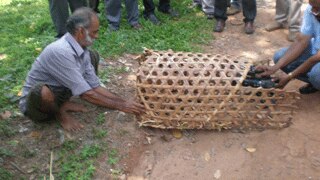
He is the super star in this tour. A man with a long mo stash. He makes a traditional Fish traps (Raalkkoodu)which is used for lobster catching. What makes Raju so special is the fact that he belongs to the few who had mastered the art of making raalkoodu. Raju demonstrated the art of raalkoodu making with all the details from the raw materials to the making. Lobsters are one of the most expensive fish found mostly in the deep sea. It involves spectacular skill and hardship to catch them and raalkoodu acts as the special trap used for this purpose. There are 3 types of lobsters: Pulikannan- the heaviest of all (2.5 kg), Columbus (1kg) and the Chemraal(1kg), the taste and the price may vary between each variety. The raalkodu mode of capturing lobsters is practiced only in Kerala. The traps were placed near the side of rocks under the sea by expert swimmers. The trap can be adjusted in such a way that only big fishes are trapped and small fishes can escape. This is why it is considered as a ecofriendly model. This method is used in the season from August to May as the lobsters are in plenty in these periods. The lobster normally costs upto Rs 800 per kg. Working of a raal koodu is mentioned by Mr. Raju. There are 3 parts in a raal koodu, the top, bottom and a gate. The same trap can be made out of iron, but it rusts in due to saline sea water and is expensive. The natural fibre raal koodu can be used for one month and it is less expensive. It takes only one hour to build one and five of such kind can be built in a day. The indigenously designed traps for catching the fish are a thing of immense interest.

After this nice experience we were served with a sumptuous lunch which includes fish curry, fish fry, aveel, sambar, pappadam, paayasam etc. Really tasteful and elaborate. Took a small rest. Next we walked into the world of Kalarippayattu, the most ancient martial art of God\'s own land. It is the martial tradition of self defence practiced in Kerala and it has its roots deep in the Vedic culture of India. The Kalarippayattu is possibly one of the oldest fighting systems in existence and it includes strikes, kicks, grappling, preset forms, weaponry and healing methods. YDM kalari was formed in 1980. Urumipayattu, vaalpayattu, karuvadipayattu, kalaripayattu, neduvadi payattu etc are the different types of kalari.The commonly used arms are sword, knife, etc. In the Handicraft unit, we had a close look on the handicrafts by Women groups in this area. The main item of their production is Kathakali Mask. The waste paper from the press is recycled and used for the preparation of Kathakali mask. The paper is dipped in water for about one month and powdered. The paper pulp, chalk pieces and gum from tapioca is mixed and dried. Then flour is added and dried. It is polished using sand paper, put colours and then add tags on its back side and thus the mask production is completed. We have purchased some interesting models.

After this we moved to a Handlooms unit. It was really fascinating to see the handloom weaving of the cloths using silk and fine threads of gold and silver. The clothes are made out according to the needs of the customers. The embroidery designs are really marvelous and mostly golden borders are used for clothes. Wearing these clothes on marriage and other functions gives the feel of traditional-royal style. The price of the handloom clothes ranges from 1500/- to about one and half lacs, depending on the designs and quality. The handlooms were supplied to the major show rooms and textile shops in the city. No women are working in this field. One month is needed to weave a saree and one saree is weaved by a single person. People who have recieved Padmashree award from President A.P.J Abdul Kalam are also working here.

We also explored the life beyond the Kovalam Beach marks an end with demonstration of traditional fishing at Vellayani Lake. The banks of the lake offers perfect ambience to sit and relax for some time. This place covers 70 hectares of land filled with greenery. The lake is rich in a variety of fishes and migratory birds. White crane, kingfisher, eagle, wood pecker etc reside here. Different varieties of lillies and lotus can also seen here. Before one decade the water from the lake was used for irrigation. The Vellayani Lake is indeed a great advantage to the farmers. We really amazed my the village beauty of Kovalm. I think no one imagine such beauty ever. Thanks to Anil. Thanks to Kerala Toursim


Read more

Eves on top of the world

0 comments
A women's only group visited the Himalayan terrain recently and they share their experiences with Priyadershini S.
The hills of Ladakh came alive to the happy hullaballoo of a Malayali group of women who visited the place recently. So mesmerised are the women that the party continues even after they are back.
The trip was organised by ‘Women Explorers' club (WE), a travel club that aims to bring like-minded women, who travel together, to interesting places within and out of India, and through this exchange of ideas, explore opportunities, form new friends and above all, have loads of fun.
Their smitten hearts and intrepid minds are still hankering for the gentle people and picturesque scenes they have left behind. The mountains, valleys and rivers of Ladakh saw them trek, climb, dance and even revel in white water rafting.
The women were beside themselves with excitement, at a recently held ‘hangover' party at the Yacht Club and had lots to recount. They relived every moment of their trip spent in the icy cold environs with “most warm hearted” Ladakhis. The trip to the roof of the world, their Himalayan odyssey, seemed to have changed each one of them in one way or the other.
Deepa Varma, trip co-ordinator, is thrilled that this first-of-a-kind vacation, which her company undertook went off without a hitch.
A sense of déjà vu filled the 17 holidayers, comprising a grandma, professionals and homemaker, as they took off from Kochi and opened up homemade tuck on the flight. Landing in the capital, it was a dash to the known shopping centres, a typical girlie thing to do. But no one had an inkling of what lay ahead, of how the grandeur and beauty of nature would soon overwhelm them so completely. One of them remarked at the end of the trip, “Luxury trips don't hold much for us anymore.”
Forewarned about altitude sickness, about walking or running fast it was a slow motion introduction to Ladakh. Once acclimatised to the cold rare mountain air, the women were up and about the place.
The city of Leh was the starting point. A visit to the Shanti stupa, the world's largest Buddhist temple, constructed by a Japanese Buddhist organisation, ‘The Japanese for World Peace' , was followed the next day by a six-hour drive through the Khardungla Pass (the world's highest motorable pass) to the panoramic Nubra Valley.
The stopover at the world's highest café in Khardungla Pass (18,300 ft) left the women breathless. They danced by the wayside in gay abandon, excited at the beauty and bounty of Nature, looked curiously upon by convoys of passing soldiers.
The pass opened on to the cold desert where the two-humped Bactrian camels were a sight to behold. The journey through hail, snow, rain, river and desert took them through the wonders of Nature. The Zanskar River, the changing colours of the mountains, the banks of Panong Lake, where the climax of ‘3 idiots' was shot, lush and ripe apricot and green apple orchards, stirred the women. It was “too much fun” but quite surreptitiously the women seemed to undergo a change of heart. Fun gave way to an acknowledgement of a new way of life, of unseen beauty and unseen terrain, a mystery, a peace and calmness that Buddhism speaks about. The scenery left them astounded and the group grew closer, joined by an experience of a lifetime. Long walks, breathless nights, dancing by the camp fire, savouring Tibetan food, watching traditional Ladakhi dances, savouring tupka- a soupy noodle preparation, standing on the famous Silk Route, trustworthy inhabitants, polite and courteous, the group imbibed it all. The grand finale came as they negotiated the cold icy deep rapids of the Zanskar, helmeted and jacketed, ready for the rough-and-tumble and finally coming out trumps.
“I don't even know how to swim”, said Bindu Sydney, “but we as a group were undeterred”. They completed their course with a sense of achievement.
By now they were united by five crazy days of waking and sleeping in a magical land, fused by friendship and team spirit, delighting and living every moment. Back here, the group says in unison, “the people of Ladakh are most warm hearted and trusting. Everyone, once in a lifetime, must visit this place on earth.”
For more details contact 0484- 2381883 /2381663. 

-Priyadershini.S


Read more